Reflections about historical research and digital tools
Each blog post below discusses a digital tool. Several posts have been grouped into three broader topic pages: Research Tools, Communication Tools, and Visualization Tools.
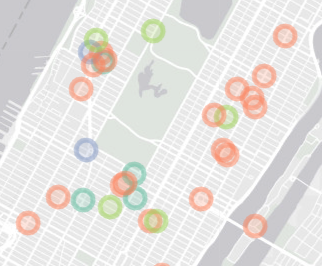
Risky New York: Gendered Spatial Practices Between the Gay City and the Normative City
May 12, 2023The study of historically marginalized groups and their presence in, movement through, and production of space must be conceived in consideration of the multiple ways through which those groups, in historian George Chauncey’s words, sought “to claim space for themselves in the midst of a hostile …
read more
Tableau: Inquiring Far and Beyond with Data Visualization
December 14, 2022To experiment with Tableau, an interactive data visualization application, I acquired data in XLSX format from the National Register of Historic Places online database. The spreadsheet contained information on all the properties listed in the National Register until 2022 for local, state, national, …
read more
Palladio: Everything is Connected
December 14, 2022As surprising as it sounds, for a long time historians overlooked implicit connections between things, people, organizations, and ideas across time and space. But they were not unfamiliar to the idea of networks. As a crucial part of historical scholarship, historiographical works are fundamentally …
read more
Voyant and Text Mining: When Quantitative Meets Qualitative
December 14, 2022When Dr. Leisl Carr Childers introduced me to Voyant during her graduate methods seminar at Colorado State University, I realized a few things. First, that historians can take for granted the textual nature of traditional primary sources. The structure, vocabulary, and terms of a textual corpus tell …
read more
StoryMaps: A place-based form of historical narrative
December 13, 2022Professor Elizabeth Tulanowski’s introductory class on Geographic Information Systems at Colorado State University exposed me to ArcGIS tools. Developed by Esri, the world’s leading supplier of GIS software and tools, ArcGIS tools are not open source. They are, however, available to most …
read more
AirTable: Data Management and Collaboration
December 13, 2022Dr. Amanda Regan, my supervisor and co-director of the digital mapping project Mapping the Gay Guides, first introduced me to AirTable when I started to work as a research assistant in the project. Since Mapping the Gay Guides depends on the collaborative work between many researchers and graduate …
read more
Omeka: Curatorship and exhibits in the digital age
October 16, 2022The great thing about Omeka is that it is an open-source system. The software is what we call a content management system (CMS), and the terminology is mostly self-explanatory: it increases the user’s ability to. manage and showcase digital contents in the form of a dynamic virtual exhibit. …
read more
Organize your mess: Tropy and historical research
October 5, 2022In the summer of 2021, I did my first solo research trip. With little time to prepare, I had one major goal to accomplish while in Chicago: to take as many pictures of historical records as I could. I had two days to visit the Chicago Public Library where most of the materials relevant to my …
read more
The day has finally come: Zotero has found me and it's here to stay
September 24, 2022I never really loved dishwashers. One of the few things that gives me some sense of control over the chaos of life is washing my dishes. I take my time and choose the order, the pace, and the method I will use to get everything clean and dry.
I was highly skeptical of Zotero when I first heard about …
read more
Coding: Baby steps towards a new form of communication
September 7, 2022Of course, the first blog post of the Time Sensitive is about coding. Not because I love it madly, but because coding may be one of the most, if not the most important and difficult learning curves in the career of aspiring digital historians. As someone who speaks three languages, reads four, and …
read more